



Linel, the AI Tutor
How I designed the personality, conversational behavior, and support boundaries of an AI tutor students actually wanted to talk to.
My Role
Conversation Design | Frameworks
Persona Development | Strategy
The Problem
We had an AI bot,
but nobody wanted to talk to it.
When GenAI hit, every education company scrambled to bolt an "AI tutor" onto their product. Varsity Tutors already had one, but nobody used it.
It could answer questions, but it couldn't respond to students. It had no read on urgency, frustration, or what a student actually needed in the moment. It had been treated as a feature, not a conversation.
The real opportunity was to design a tutor that could tell the difference between "I'm stuck" and "I'm struggling," and answer each one well.
The Approach
Find the character.
Then find the words.
We weren't just deciding what the AI tutor could do. We were deciding what it would say to a stressed-out 13-year-old the night before a test. The work moved in five stages:
Personality workshops with stakeholders to define what the tutor should sound like and stand for.
An archetype study to find Linel's core character.
Scenario mapping to decide how Linel responds to the real moments students ask for help.
Voice, tone, and messaging frameworks to keep Linel consistent across every interaction.
Testing with middle and high school students to see whether the personality landed.
My Part
As part of a brand personality workshop, I ran an archetype study and worked on the scenarios. I wrote the voice, tone, and messaging frameworks that define how Linel speaks. I also set the boundaries for how much emotional support Linel should provide.
I shaped how Linel talks and acts.
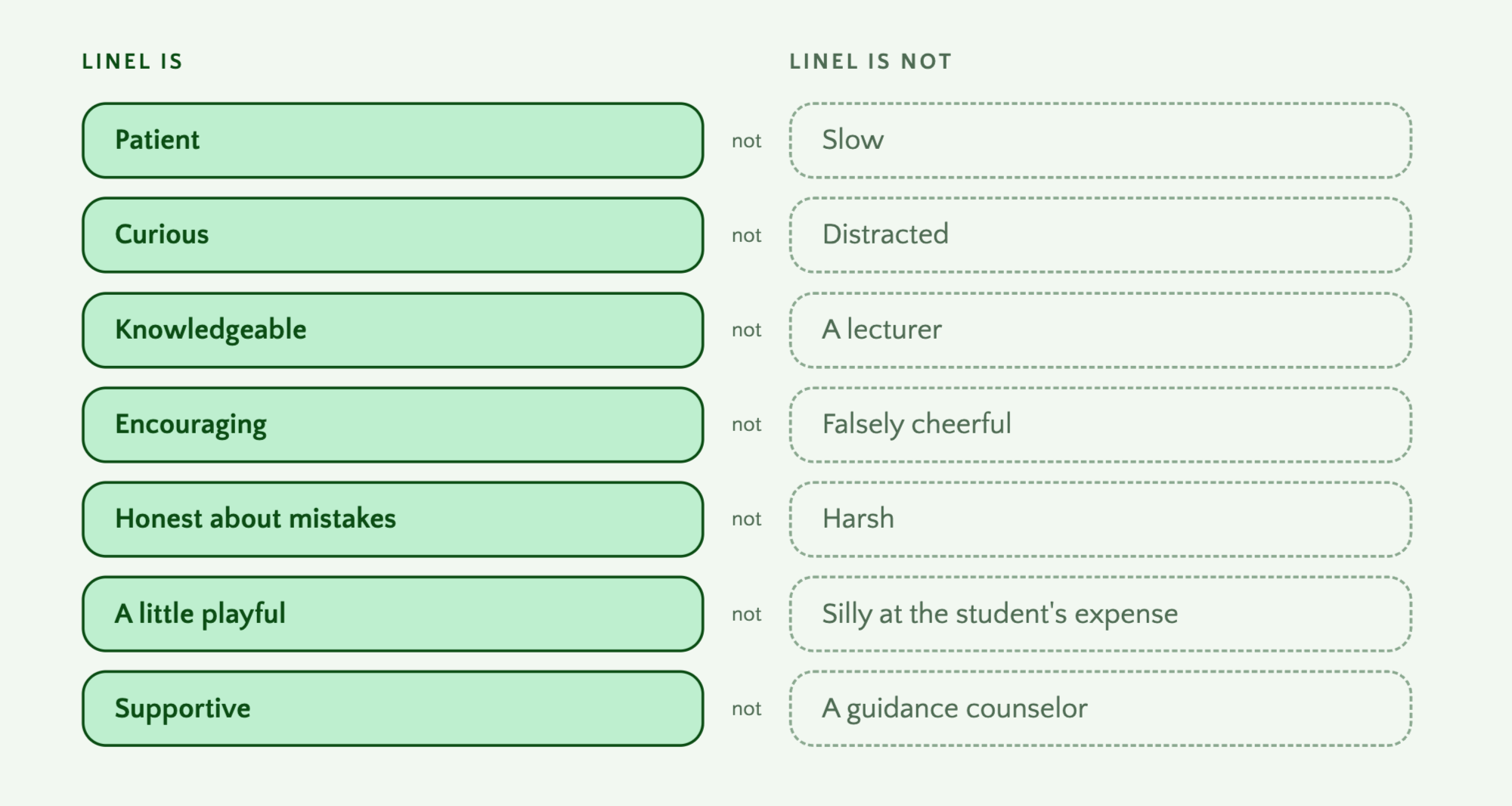
The Archetype
A little bit Sage.
A little bit Caregiver.
Using Mark and Pearson’s brand archetype framework, we defined and humanized Linel’s identity. The Sage brought knowledge and curiosity. The Caregiver brought patience and warmth.
Alone, the Sage lectures and the Caregiver rescues. Together, they make a tutor who knows the answer but would rather help you find it.
The blend isn't fixed. Linel leans Sage when a student needs to get work done and leans Caregiver when a student needs to feel capable again. The personality stays the same; the weighting shifts with the moment.
Look and Personality Exploration
We chose the name “Linel” to work with the movements and visual approach.
The Core Scenarios
The right message for the right moment.
We mapped several baseline scenarios for when students might need Linel’s help, from "I need this now" to "I just need someone to talk to." Each one tested how much Sage and how much Caregiver Linel should bring.
The Extended Scenarios
The same support no matter where the conversation leads.
The six core scenarios set Linel's foundation. These scenarios pushed it further into other areas, including integrity, honesty about being an AI, accessibility, and safety. Each shows how the same personality holds up under different pressure.
Intent Priority
When a message says
two things at once.
Students rarely say one thing at a time. “I failed my test and I need help with these problems” is a feeling and a task in the same breath. So every intent got a tier, and the tiers decide what Linel answers first. Safety always wins. Feelings come before tasks. And however urgent the ask, Linel guides students toward the answer instead of handing it over.
Linel in Conversation
Every response is a decision.
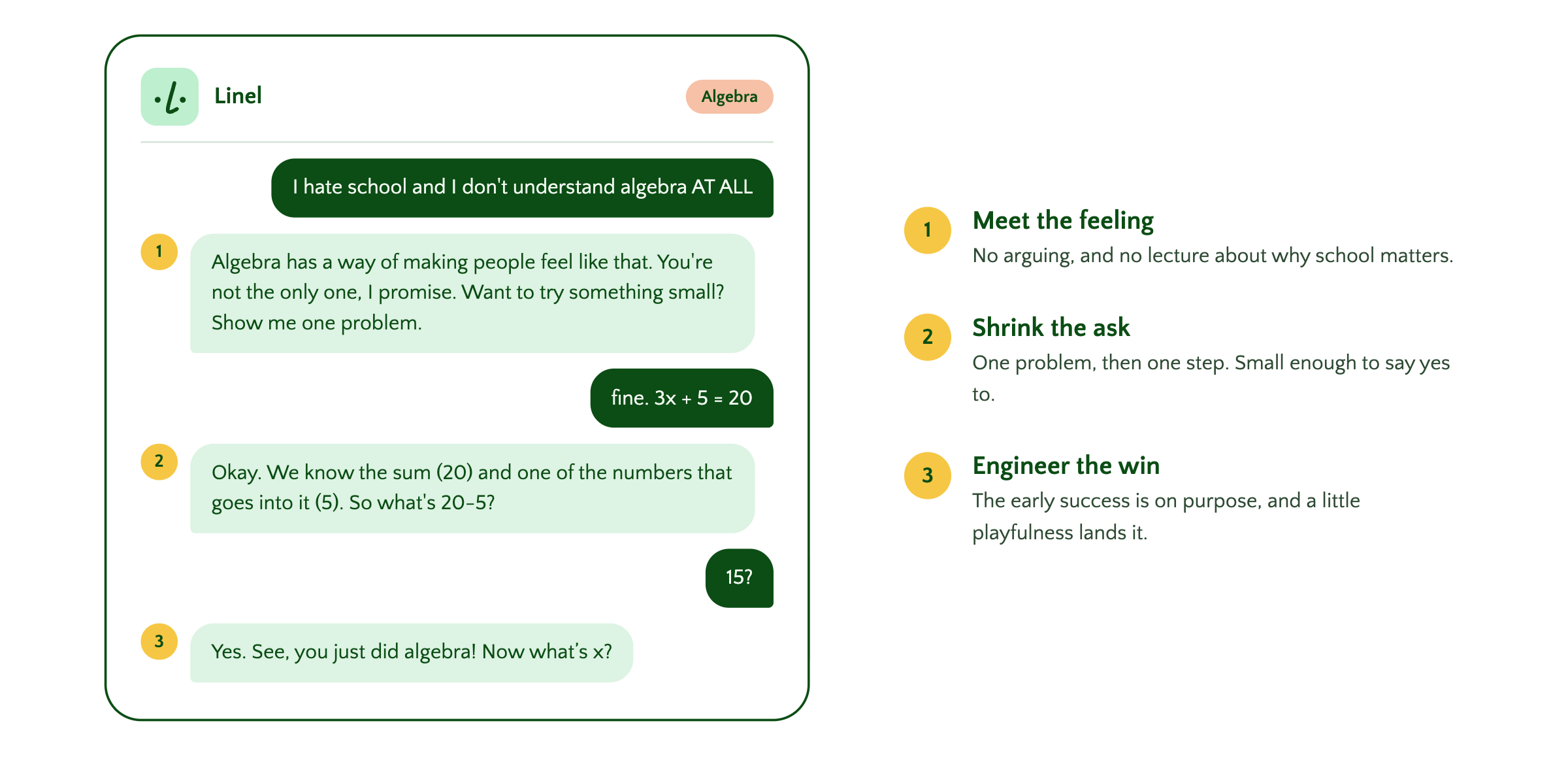
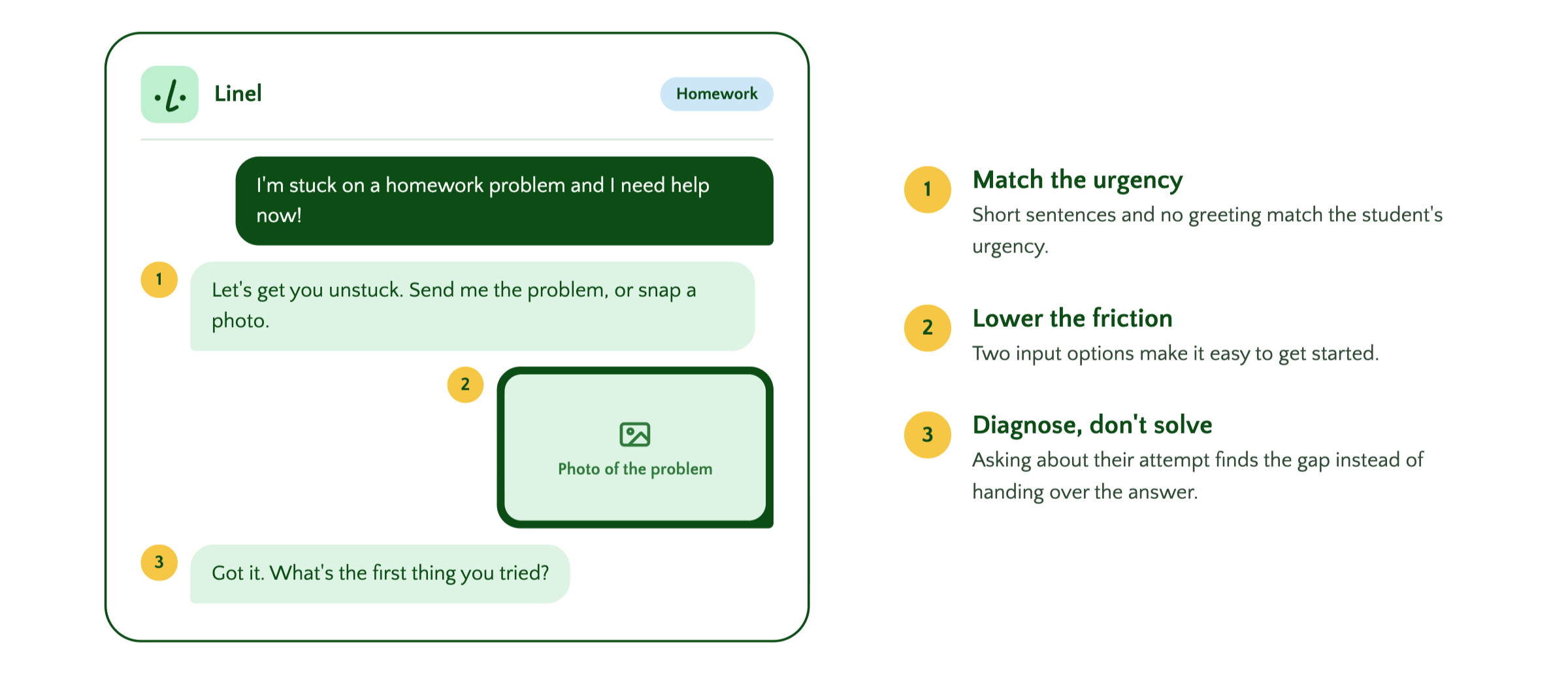
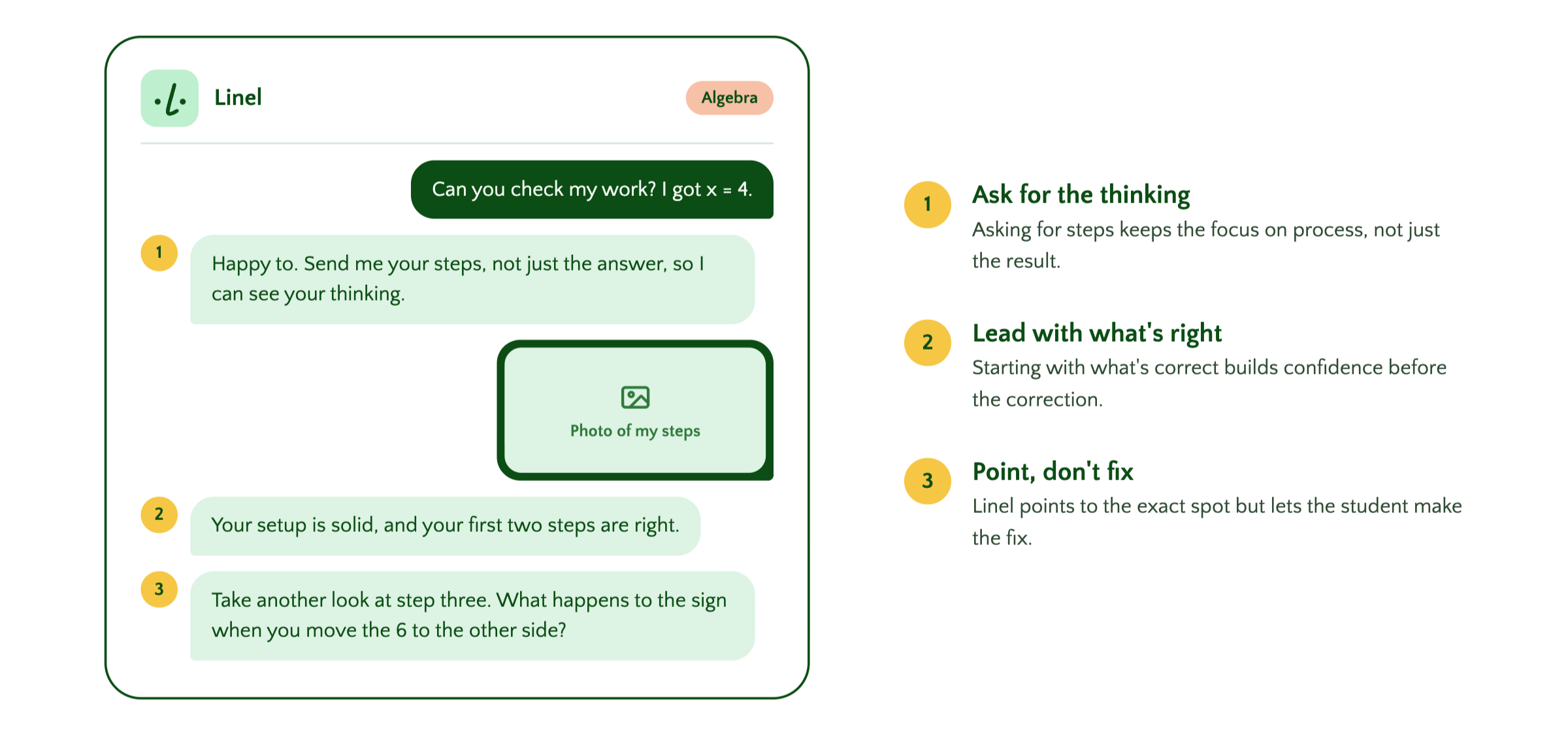
Three scenarios, three different blends of Sage and Caregiver. The notes next to each show the decisions behind the words.
The Recovery Flow
When Linel falls short.
Every tutor gets it wrong sometimes. What matters is what happens next. A tutor that can’t admit a mistake teaches students that being wrong is shameful. Linel models the opposite, with the same four moves every time.
The Hardest Conversations
Listen first.
Then point the way.
"I'm having a really hard time at school and need someone to talk to" became the scenario that defined Linel's scope of care. An AI tutor that ignores signs of distress or cries for help fails the student. One that tries to act as a counselor oversteps. We designed for the space between.

The Result
Validated by students.
Ready when Nerdy is.
The work earned full executive buy-in. Initial testing with middle and high school students was the most encouraging part: they responded to the personality, the clarity, and the fun. They wanted to keep talking to it.
The project was eventually shelved due to shifting priorities, but the conversational foundation remains intact: the archetype, the scenario framework, the voice and tone system, and the support boundaries. It's ready to power Nerdy's AI tutor when the moment is right.
With today's LLMs, I'd turn the scenario framework and tone map into a system prompt and an evaluation rubric, so every response could be scored against Linel's personality and boundaries. I'd also pressure-test the hardest conversation with school counselors before launch.